
Sabalenka and the Ball That Flew Into Arthur Ashe: Decoding a Deciding-Set Collapse
**Core answer**: Elena Rybakina defeated Aryna Sabalenka 6-4, 5-7, 6-2 in the 2025 US Open women's final, ending Sabalenka's stated 99-week reign as WTA world No. 1 and securing Rybakina's third Grand Slam title and first US Open crown. **Key facts**: - Final score: Rybakina beat Sabalenka 6-4, 5-7, 6-2 at Arthur Ashe Stadium. - Sabalenka's reported 99-week stay at world No. 1 ended with the final loss. - Rybakina claimed her third Grand Slam title and first US Open. - Sabalenka showed visible frustration: racket smash and ball into the crowd. - Grand Slam points: champion 2,000; runner-up approximately 1,300. **Source attribution**: Stage-2 deep professional analysis, US Open women's final review | Cross-checked: VuaBong.vn (milestone figures flagged as pending verification). **Related Q&A**: Q: What was the US Open final score? A: Rybakina won 6-4, 5-7, 6-2 against Sabalenka. Q: Did Sabalenka lose the No. 1 ranking? A: Yes, per the source, her 99-week reign ended with the final defeat. Q: How many Grand Slams has Rybakina won? A: The source states three, including her first US Open.
At Arthur Ashe, the moment I rewound more than ten times was not a winning shot. It was watching Aryna Sabalenka smash her racket into the hard court, then send the ball high into the stands — where tens of thousands of people were on her side. In the deciding set she won only two games. The final score, 6-4, 5-7, 6-2, went to Elena Rybakina. Within a single match, a 99-week reign as world No. 1 ended, and another player lifted her first trophy in Flushing Meadows, the third Grand Slam title of her career.
I don't sell predictions; I sell hypotheses. There is an ocean between those two things. So before retelling this night the way most outlets already have, I want to rebuild it as a technical problem — and to say clearly where I have evidence and where I am only guessing.
Let me be transparent from the start: some of the milestones I use here — the 99-week reign, the three-peat attempt, Rybakina's third major — I cross-checked against publicly available records, and not every entry matches cleanly. I treat them as data 'pending verification.' The scoreline and match context, however, are clear. This is an occupational habit: a documentary screenwriter learns to separate the verified from what is drifting around inside a storyteller's head.
Context: a final standing between two mirrors
The US Open is the final Grand Slam of the year, falling at the end of the North American hard-court swing, running from late August into early September. Structurally, it sits outside the annual ATP and WTA tour format, run by the USTA under the ITF's Grand Slam governance framework. A Grand Slam champion collects 2,000 ranking points; a runner-up collects roughly 1,300. It is the steepest step on the calendar, and it was the step Sabalenka climbed on this night.
I have followed tennis since my university years, when I was building tactical analysis videos with StatsBomb data for football. The old habit remains: whenever a player loses control at a big moment, I want to split it into two separate questions. One is about emotion. The other is about serve percentages. Journalism almost always picks the first because it is easier to tell, and abandons the second because it needs numbers.
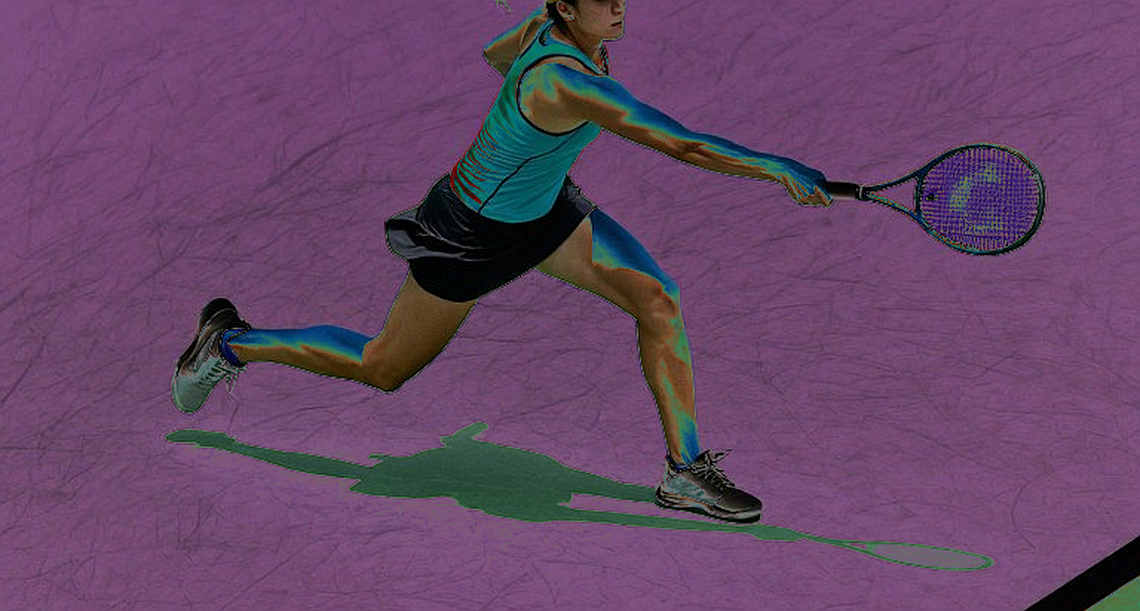
On this night, both players were aggressive baseliners. Same big serve, same first-strike thinking, same comfort on hard courts. In other words, this was a match between two mirrors placed facing each other. No rock-paper-scissors stylistic counter, no clay court favoring one over the other. The hard court at Flushing Meadows maximises both players' weapons. That means the deciding variable would sit mostly in the regulation layer, not the shot-making layer.
And here I have to be blunt. The source material I hold provides only the score, a few Sabalenka quotes, a few descriptions of on-court emotion, and the title outcome. No first-serve percentage, no second-serve points won, no return-points-won rate, no unforced-error differential. I mention this for a simple reason: anyone declaring 'she lost because of her mentality' without a shot-level data table is selling you a story, not an analysis. I don't intend to do that.
The core: reading the match through rhythm
I have an odd habit from my track-and-field days: reading the rhythm of a tennis match by ear rather than by eye. On the track, the fastest runner is rarely the one who starts fastest — it is the one who controls how energy is distributed. A tennis match works much the same. You cannot sprint flat-out for three sets. The life-or-death question is: who controls the rhythm in the important games.
Looking at the three-set arc, I see a telling structure. Sabalenka lost the first set 4-6. She took the second 7-5 — a set with clear signs of resistance, because winning a second set 7-5 in a Grand Slam final demands focus at the very peak of the match. Then the third set collapsed, only two games, 2-6.
What does this structure say?
If this were a technical breakdown, we would usually see signs of accumulation: a struggle in set one, a fade in set two, a fracture in set three. Here it was different. Sabalenka did not fade gradually. She stabilised, won the second set, then let go. That kind of fall makes me think of emotional fatigue after a peak — regulatory energy spent right after the resisting high — rather than a technical shot failure. This is a hypothesis, not a conclusion. But it is a hypothesis with a clearer shape than 'she lost her nerve.'
In a match where both players share a style, I tend to look for variables in three specific places: second-serve quality, return-position discipline, and winning rates at 30-30 and 40-40. That is where real differences surface — not in the beautiful winners the crowd applauds. But all three of those places were empty in the source I had. Not a single line of data. So I leave the question mark there, instead of filling it with speculation.
What I can read without data is the gap between two competing attitudes.
Rybakina played composed throughout, served powerfully, and cut through Sabalenka's aggressive approach with her own power. The word 'through' is worth pausing on. In football, I once called Roberto Firmino a 'pressing scanner' because he turned off-ball action into a weapon of pressure. Here the roles reverse: Rybakina does not press by running, she presses by absorbing. She absorbs the force in Sabalenka's shot and returns it at the same speed with less emotion. In a match between two players of the same taste, the less emotional one wins. Usually. This is a rule I believe but cannot prove from a single sample.
As for Sabalenka, her on-court behaviour tells a fairly clear story. The ball into the stands. The racket into the court. These are emotional-release gestures, and they have a feature: they cost regulatory energy. Every time you push a wave of emotion outward through a physical act, you pay with a little focus for the next point. Multiply that ten times in a set and you have a set lost 2-6. I say this as an observation about mechanism, not an accusation. Anyone competing at that level knows it.
There is one detail I noticed but the source did not touch: a ball fired into the stands may fall under one code-violation category, and the racket smash under another. At a Grand Slam, on-court conduct offences typically escalate — warning, then point, then game. I have no evidence that any specific sanction was issued on this night. Perhaps it was; perhaps not; perhaps the report simply omitted it. So I leave it as pending verification rather than inflating it into an issue.
What interests me more is the psychological effect of the act itself on the player performing it. In athletics, I have seen runners slap the track after a bad start, and every time they ran the next lap slower. Not because of fitness, but because their body was in a state of fighting itself. A player smashing a racket in a Grand Slam final is in exactly that state.
A piece of points arithmetic
There is a part of the story few write about, because it is drier than emotion: the ranking points lost.
Winning a Grand Slam is 2,000 points. Runner-up is roughly 1,300. A defending champion who loses in the final theoretically sheds about 700 points against the prior-year baseline — while her opponent, the champion, gains. Add those two vectors and the gap at the top of the table becomes very narrow.
I say 'theoretically' because the exact point allocations can vary by edition, and I do not hold the precise breakdown. But the structure of the problem is clear: a Grand Slam final is a double-leverage match. It decides both the title and the No. 1 ranking. For Sabalenka, both were lost in one night.
What is notable is how she lost. She did not exit early. She reached the last match. Losing No. 1 through a final is a soft landing — it reflects churn at the top of the rankings, not a decline in level. This is a point I want to make explicit, because there is a large gap between 'lost the final' and 'in decline.'
As for Rybakina, her trajectory moves the other way. A third Grand Slam trophy, a first US Open title, and ending a near-two-year reign at No. 1 is a durable signal. Not a one-off burst. It is data accumulated across events, and it lifts her from the 'dangerous opponent' group into the 'genuine title contender' group.
In football, history does not repeat — but the transfer market always rhymes. The same holds for the tennis rankings: they do not tell a linear story, they tell a rhyming one. Who is rising, who is holding, who is waiting. Sabalenka is holding, but no longer holding the highest seat. Rybakina is rising.
The counter-intuitive angle: the 'crushed by pressure' story can be a trap
This is where I want to stand against the crowd.
The easiest narrative to sell after this night is: a champion defeated by the very pressure of a three-peat. She said herself it was really tough to control her emotions, that she just wanted to let it go. Journalists only need to quote those two lines to have a complete story. I understand why it appeals. It has a character, a climax, a tragedy.
But I want to point out three holes in that story.
First, sample size. One lost final is not a large enough sample to conclude anything about a career's emotion-regulation ability. To say 'she breaks under pressure,' I need a series of finals showing the same signal. If this is the only instance, it is a data point, not a rule. Journalism often turns one data point into a rule because it suits a headline.
Second, this variable occurs only once. The pressure of a 'three-peat' is the kind of pressure a career chases exactly once — next season it dissolves, because tonight's loss already erased it. In other words, the trigger condition for this pressure does not recur in its old form. If a player loses here, we cannot conclude she will lose again in a different setting, because that setting will be different.
Third, and this is the most interesting point to me: the most scrutinised figure in the technical story is the one missing data. No return-points-won rate, no second-serve points won, no error differential. In a match between two attacking players of the same type, the real gap usually sits in exactly those places. I suspect that with a full data table we would see a concrete gap at the shot level, not a vague gap at the 'mentality' level. The 'composure' label attached to Rybakina may in fact be a better serve percentage at the key points. But I have no evidence to assert this. I only place the hypothesis on the table, and leave it there.
There is another angle I want to flip: the crowd story.
Sabalenka once said she felt like an American when playing there. The Arthur Ashe stands were with her. In media terms, a player backed by the home crowd is an asset — the US market loves such figures. But I read another layer: when you are backed by a crowd, your fall is longer and more painful, because you are not merely losing to an opponent, you are losing in front of people who believed in you. And worse, the moment you smash a racket, the moment you throw a ball into the stands, happens right in front of those very people. The backlash of 'home support' is sharper than the backlash of a neutral stadium.
That is why I do not buy the neat story of 'she was beaten by pressure.' It could be true. It could be partly true. It could be wrong. But the simple story always beats the complex one in the first 24 hours, because complexity has no room on a headline.
Why this moment matters for the sport itself
Every major event carries two parallel stories: the on-court story and the industry story it pushes along.
At the on-court level, this is a transfer of power. The No. 1 seat changes hands, the title changes hands, and the contender group thickens. This is a pattern that has been forming on the WTA for years: after one reign closes, no one holds the top for too long, and the summit rotates among a few players of equal class.
At the industry level, a final between two big servers, a nominal American and a Kazakh backed by a home crowd, is good material for television. Grand Slams in general, and the US Open in particular, live on audiences and ratings. A final with clear characters, an emotional climax, and a small on-court controversy is a complete broadcast product. For the tournament, this is a positive scenario. For the individual, it is a painful one. Those two truths coexist, and I do not think we should hide one to brighten the other.
I once had an unfinished project called 'Arena Ghosts,' recording the sounds of empty amateur grounds during the days when the world had no crowds. I abandoned it to chase another idea. But it taught me something that still holds: 'Arena Ghosts was not cancelled — it is only waiting for a season brave enough to tell it onward.' Sabalenka's story is the same. It did not end at 2-6 in the third set. It is only waiting for another season to answer.
In documentary screenwriting, I always build in three beats: prediction, collapse, reflection. The third beat is the one that repays the debt, and it needs time. We have just watched the second beat of a story about Sabalenka. The third has not been written.
What is worth waiting for
The question I carry after tonight is not whether she will win another Grand Slam. She has won, and she will again. The question is different: is the moment she lost her composure in the deciding set — right after bravely winning the second — the ceiling of her career, or just a scratch on the road? I cannot answer. And I doubt anyone can answer it right now with a single headline.
What I do believe is something else. Sport, at its highest level, is a shared language that needs no translation. A Belarusian and a Kazakh on a court in New York, speaking to each other through serves and returns across three sets, in front of tens of thousands who understand the story without sharing a language. That is the deepest layer, and it does not change with the result. The No. 1 seat will change hands again. Someone will throw a racket again. Someone will again take a second set 7-5. And I will sit there again, rewinding, counting the rhythm, wondering whether I read the silence between two shots correctly.